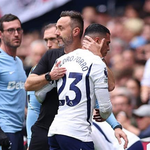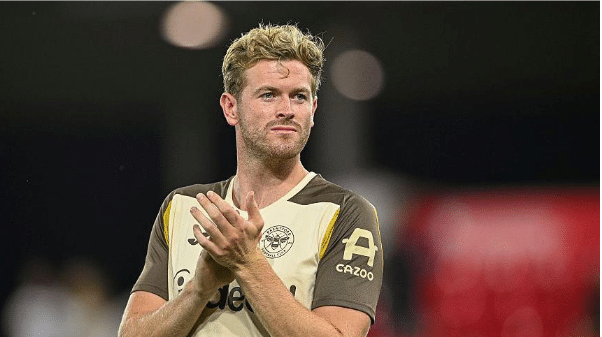
According to Xoilac trực tiếp bóng đá, Nathan Collins is a footballer whose career has been defined by a maturity that has always outpaced his years. At just 24, he has already captained a professional club, played every single minute of a Premier League season, and worn the armband for his country. His story is not one of flashy prodigiousness, but of steady, relentless elevation—a centre-back who has turned reliability into an art form. This listicle traces the five defining milestones that have shaped a player who, in the words of those who know him, is simply a born leader.
1. A Footballing Bloodline and the Move That Started It All
Nathan Michael Collins was born on 30 April 2001 in Leixlip, Ireland, into a family where football was not just a hobby, but a shared language. His father, David, had been on the books at Liverpool and played alongside Roy Keane for the Ireland Under-21s. His uncle, Eamonn, was an Ireland youth captain, and his cousin, Mikey, also represented his country at underage level.
This environment shaped Collins from the earliest age, but it was his own drive that took him across the water. At just 15, he left Cherry Orchard, his youth club in Ireland, to join Stoke City’s academy in England. The move was a test of character as much as ability, but it laid the foundation for everything that followed. He progressed rapidly through the ranks, and his senior debut arrived in April 2019, aged 17, in a defeat to Swansea City. Just ten days later, he made his first start, and a career that had been meticulously prepared was finally underway.
2. The Stoke City Record and the Premier League Education
The 2019/20 season was Collins’s breakthrough. He became a regular in Stoke’s Championship side, and in a Carabao Cup tie against Wigan Athletic, he was handed the captain’s armband at the age of just 18 years and 105 days, making him the Potters’ youngest-ever captain. That record was not a ceremonial gesture; it was a recognition of a leadership quality that coaches had identified early. He made 27 appearances in his final year at Stoke, before Burnley came calling in June 2021, offering him his first taste of the Premier League.
His single season at Burnley was one of adaptation. He made 19 top-flight appearances, scoring two goals, and although the club was relegated, Collins’s individual performances marked him as a defender of genuine Premier League quality. Wolverhampton Wanderers moved quickly, signing him for a reported £20.5 million in July 2022. At Molineux, he played 26 league games, continuing his education against the division’s elite forwards, before Brentford identified him as the defender around whom they could build their future.
See more: https://experts-univers.com/lich-thi-dau/
3. Finding a Home at Brentford and the Iron Man Season
Collins joined Brentford in the summer of 2023 for a club-record fee, and the move immediately felt like the right fit. In his first season, he made 35 appearances in all competitions and scored his first league goal for the club in a dramatic 3-2 win over West Ham United.
However, it was the 2024/25 campaign that cemented his status. Collins became the only outfield player in the entire Premier League to play every single minute of the season, a remarkable feat of durability and consistency that produced 38 consecutive starts at centre-back. This was not a statistical anomaly; it was the product of a defender whose reading of the game, physical robustness, and disciplined lifestyle allowed him to withstand the relentless demands of English football’s top flight. That season of relentless availability was the ultimate proof that Collins was no longer a promising talent—he was a cornerstone.
4. The Captain’s Armband and the Irish Honour
In August 2025, following the departure of Christian Nørgaard, Nathan Collins was named Brentford’s club captain ahead of the new Premier League season. The appointment was the natural culmination of his journey at the Gtech Community Stadium. He had arrived as a young defender with potential; he was now the leader of the dressing room, the player who set the standards and carried the responsibility of the armband.
On the international stage, the same story has unfolded. After making his Republic of Ireland debut in October 2021 against Qatar, Collins grew into a central figure for his country. In September 2024, with regular captain Séamus Coleman injured, Collins led Ireland out for the first time. The moment was profound, not just for him, but for his family. “Some of my family were crying in the stands,” he recalled. “If I looked at them, I’d have probably started crying myself”. For a family with such a deep footballing heritage, the sight of Nathan captaining his country was, as he put it, “the biggest honour I’ve had in my life”.
5. The Leadership Test and the Resilience of a Captain
The 2025/26 season has tested Collins in a new way. He has faced injury interruptions, missing international windows with a calf problem and later a knee injury that ruled him out of crucial Nations League fixtures. Watching his teammates from the sidelines was, by his own admission, a “stressful” experience, one that made him feel he had left his team “on their own”.
Yet, these setbacks only reinforce the central theme of his career. Collins’s value is not measured solely in his own performances, but in the stability he provides to those around him. Whether he is marshalling the Brentford defence, captaining Ireland, or navigating the disappointment of injury, he carries himself with the same composed authority. He is a defender who leads by example, whose durability has been proven, and whose maturity remains his defining attribute.
Conclusion: The Quiet Architecture of a Captain
Nathan Collins’s biography is not the story of a footballer who relied on innate brilliance to reach the top. It is the story of a player who built his career on the solid foundations of family heritage, seized his early opportunities at Stoke City, proved his durability in the Premier League, and earned the trust of two dressing rooms to lead them. He has been a record-breaker at 18, an iron man at 23, and a captain at 24. At every stage, he has answered the question of whether he belongs with the same quiet, unspectacular certainty that defines his play. The comparisons that follow him—to the great Irish captains, to the most reliable defenders in the Premier League—are well-earned. But Collins’s story is not yet a comparison. It is a sequence of milestones marked by responsibility accepted and pressure absorbed. The captain from Leixlip has already built a career of remarkable substance. The next chapter will determine how far that quiet authority can take him.